

You’re mid-conversation and someone fires back with “wtv.” Suddenly the chat goes quiet. Was that rude? Casual? Dismissive? If you’ve paused over those three letters wondering what just happened, you’re not alone. WTV meaning in text is one of the most searched slang questions online — and for good reason. It’s short, flexible, and packed with attitude depending on how it lands.
This guide breaks it all down: what WTV stands for, where it came from, how different people use it, and exactly how to respond when it shows up in your chats.
What Does WTV Mean in Text & Chat?
WTV means “whatever.” In texting and online chat, it’s used to express indifference, casual agreement, or — depending on tone — mild frustration. It’s the digital equivalent of a shrug: quick, low-effort, and deliberately vague.
At its core, WTV is a tone word as much as a meaning word. The same three letters can mean “I’m totally flexible, you choose!” or “I’m done engaging with this topic” — and telling the difference requires reading the full conversation around it.
Full Form, Stands For & Short Meaning of WTV
| Term | Stands For | Primary Use |
| WTV | Whatever | Indifference, flexibility, dismissal |
| WTVTF | Whatever the F*ck | Stronger, more frustrated version |
| WTV PC | Whatever (Politically Correct) | Expressing views without filtering |
Unlike many texting acronyms, WTV doesn’t have multiple competing full forms in casual communication. It has always meant one thing: whatever. That simplicity is exactly why it has stayed in rotation for over two decades of internet slang.
Origin, History & First Known Use of WTV
The story of WTV starts before smartphones. In the early 2000s, mobile phones used numeric keypads, and SMS messages had strict character limits. Typing “whatever” took real effort on a T9 keyboard. Shortening it to “wtv” was a natural solution — fast, easy, and clear enough in context.
Early chatrooms on MSN Messenger and AIM helped cement abbreviations like “wtv,” “lol,” and “brb” into everyday digital language. These platforms rewarded speed and brevity, so short-form typing became a cultural habit.
By the mid-2010s, meme culture on Twitter and early Instagram pushed short replies into the mainstream. “Wtv” wasn’t just a typo shortcut anymore — it became a mood. Then TikTok arrived. By 2020, the platform had made WTV a permanent fixture of Gen Z vocabulary through comment threads, video captions, and reaction content.
Interestingly, unlike “LOL” — which eventually made it into formal dictionaries — WTV stayed informal. It’s never been standardized. That’s part of its charm: it belongs to everyday people, not publishers.
How People Use WTV in Daily Conversations
People reach for WTV when they want to communicate without effort. It moves conversations forward without picking a side. Common everyday uses include:
- Ending a low-stakes disagreement — “Fine, wtv, do it your way.”
- Expressing open flexibility — “WTV works for me, you pick.”
- Showing disinterest — “Wtv, I’m not really into it.”
- Casual agreement — “WTV, that sounds fine.”
- Emotional withdrawal — “WTV. I’m done talking about this.”
The key variable is always context. In a lighthearted group chat, WTV is breezy and harmless. In the middle of a serious or emotional discussion, the same word can feel like a door slamming shut.
WTV Meaning in Text From a Girl
When a girl sends WTV, it often carries more subtext than the letters suggest. Social and communication research consistently shows that women tend to use hedged or indirect language to signal emotion rather than state it directly.
What WTV from a girl can mean:
- “I’m bothered but I don’t want to explain right now.”
- “You’re not listening and I’m withdrawing.”
- “I genuinely don’t mind — I’m flexible.”
- “I’m trying to avoid conflict.”
The phrase “Wtv, I’ll just stay home” is a classic example where the word means the opposite of indifference. That’s disappointment in disguise. Context, relationship history, and what was said just before the WTV are all essential to reading it correctly.
Pro tip: If someone who is usually expressive suddenly goes to a flat “wtv,” pay attention. That shift in tone almost always means something.
WTV Meaning in Text From a Boy
When a guy sends WTV, it tends to be more literal and less emotionally loaded. Guys more often use it as genuine flexibility — a low-effort way of saying “I don’t have a strong preference, you decide.”
What WTV from a guy usually means:
- “Either option works for me.”
- “I’m not bothered either way.”
- “Let’s just move on.”
- “I don’t want to overthink this.”
In gaming contexts especially, WTV from a guy is almost always neutral: “WTV map, I’m down for anything.” There’s no hidden meaning — he’s just not invested in the decision.
That said, a guy who uses WTV in the middle of an argument is very likely signaling disengagement or frustration, not flexibility. Read the room.
WTV Meaning Across WhatsApp, Instagram, TikTok & Snapchat
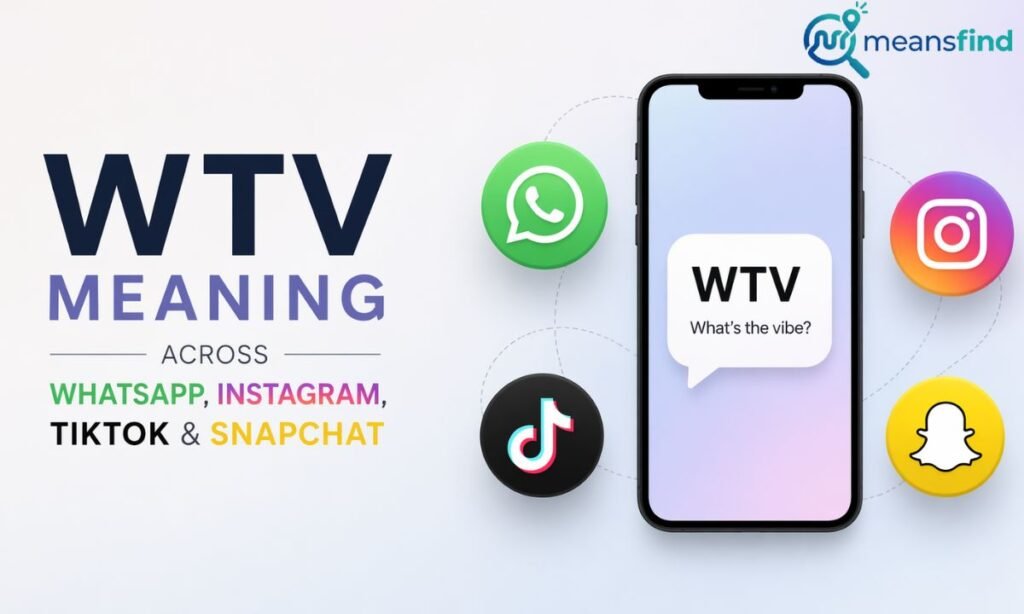
Same word, different energy — platform context shapes how WTV lands every time.
| Platform | Typical WTV Vibe | Common Use Case |
| Neutral to personal | Private chats; usually means “I’m flexible” | |
| Confident, carefree | Captions/DMs; “I don’t need your approval” | |
| TikTok | Sarcastic or playful | Comments; often ironic or humorous |
| Snapchat | Casual, breezy | Fast replies; “do what you want” |
WhatsApp conversations are typically one-on-one or in close group chats, so WTV carries more weight here. A single “wtv” in a private chat can signal real feelings.
Instagram users often type “wtv” in captions to project an unbothered, confident attitude — think “Wore this to dinner, wtv 😎.” It’s a personality statement as much as a reply.
TikTok comment sections use WTV almost performatively — it’s part of the “that girl,” low-effort, unbothered aesthetic that’s dominated Gen Z culture through 2024 and 2025.
Snapchat is fast and ephemeral by design, so WTV fits perfectly as a quick, no-pressure reply between friends.
Also Read This:DND Meaning in Text: What It Really Stands For & How It’s Used
Different Meanings of WTV in Other Fields
Outside casual texting, WTV occasionally appears in other contexts — though none are as widely recognized as the slang meaning:
- Media/Broadcasting: WTV has been used informally to reference “Worldwide TV” in streaming discussions.
- File Format: Microsoft Media Center uses the .wtv file extension for recorded TV shows — but this has nothing to do with texting slang.
- Gaming Communities: In Discord and Twitch chats, “wtv” can appear as shorthand for “whatever” during in-game decisions — same meaning, different setting.
In medical or professional environments, WTV carries no standardized meaning. If you see it in any formal document, treat it as informal or accidental usage.
Common Confusions, Mistakes & Wrong Interpretations
The biggest mistake people make with WTV is assuming it always means the same thing regardless of context.
Common misreadings:
- ❌ “WTV always means someone is angry” — False. It’s neutral until tone makes it otherwise.
- ❌ “WTV is only for teenagers” — False. Adults across all age groups use it in casual texting.
- ❌ “WTV means watch TV” — Only true for the Microsoft file extension, not in chat.
- ❌ “WTV is always rude” — Completely context-dependent. With a 😊, it’s warm. Without anything, it can feel cold.
Another common error: over-interpreting a standalone “wtv.” Before assuming someone is upset, scan the full conversation. If the previous messages were casual and light, a lone WTV is probably just a quick response — not a statement.
Similar Terms, Alternatives & Related Slang
| Slang | Meaning | How It Compares to WTV |
| IDC | I Don’t Care | More definitive and blunt than WTV |
| IDK | I Don’t Know | Informational, no attitude |
| NVM | Never Mind | Closes a topic, more dismissive |
| MEH | Meh | Similar vibe, more bored than indifferent |
| K / KK | Okay | Colder version of agreement |
| FR | For Real | Shows seriousness; opposite energy |
| BET | Okay / Deal | Positive agreement; opposite of WTV’s passivity |
The clearest contrast is WTV vs. IDC. WTV says “whatever works” — it leaves options open. IDC says “I don’t care at all” — it closes them. WTV is a shrug; IDC is crossed arms.
Examples of WTV in Real Chat Situations
Example 1 — Friendly flexibility:
Alex: “Pizza or burgers tonight?” Sam: “Wtv, you choose 🍕”
Example 2 — Ending a disagreement:
Jordan: “We should’ve taken the other route.” Riley: “WTV, we’re here now, drop it.”
Example 3 — Emotional withdrawal:
Taylor: “Are you coming or not?” Morgan: “WTV.” (No emoji. That silence says more than the word.)
Example 4 — Carefree confidence:
Instagram caption: “Not everyone’s going to get it. WTV 😎”
Example 5 — Group chat:
“WTV works for the time, I’ll be there whenever.”
Notice how the emotional register shifts dramatically across these five examples — same word, five completely different messages.
How to Reply When Someone Says WTV
Your response depends entirely on the tone you detected in their WTV.
If it felt casual and friendly: Take the decision they handed you. “Okay, let’s do pizza then!” — no overthinking needed.
If it felt passive or withdrawn: Gently acknowledge the shift. “Hey, you alright? That didn’t sound like you meant nothing by it.” Keep it light, don’t interrogate.
If it seemed frustrated or dismissive: Give it space. A simple “Okay, talk later” is better than pushing back and escalating.
If it was sarcastic (especially on TikTok): Match the energy. Play along or use humor — taking it too seriously will miss the tone entirely.
The golden rule: never assume. When in doubt, one gentle follow-up question is always better than a spiral of misinterpretation.
Is WTV Still Popular? Trends & Online Usage
Yes — and it’s not going anywhere soon.
WTV has outlasted dozens of slang trends that burned bright and disappeared (remember “YOLO” as a texting staple?). The reason WTV survives is its usable ambiguity. It’s flexible enough to mean almost anything, short enough to type in under a second, and emotionally versatile enough to work in almost any casual context.
In 2026, WTV is especially dominant on TikTok, Discord, and in mobile group chats among Gen Z and younger millennials. Older millennials use it too, though often typed out as “whatever” for clarity. The lowercase “wtv” has become the preferred style — all caps “WTV” can read as shouting or overly dramatic.
One evolution worth noting: WTV is increasingly paired with emojis to add precision. “wtv 🤷” vs. “wtv 😒” vs. “wtv 😊” are three entirely different messages in 2026 digital communication culture.
Frequently Asked Questions
What does WTV mean in text?
WTV means “whatever” — used to express indifference, flexibility, or mild dismissal in casual chats.
Is WTV rude?
Not by default. Tone and context decide everything — paired with an emoji it’s friendly, sent alone mid-argument it can feel cold.
Does WTV mean the same as IDC?
Similar, but WTV is softer and more open-ended; IDC is more blunt and final.
Can I use WTV in professional settings?
No — keep it to informal chats with friends. It comes across as careless in work emails or formal messages.
Is WTV only used by Gen Z?
No — it’s widely used across generations, though Gen Z and millennials use it most frequently.
What does WTV mean from a girl specifically?
It can signal genuine flexibility or — depending on context — understated frustration or emotional withdrawal.
How should I respond to WTV?
Match the energy you read. If it’s casual, just move forward. If it felt loaded, a gentle check-in works better than silence.
Conclusion
WTV is one of those rare pieces of internet slang that punches way above its weight. Three letters, infinite tones. At its most basic, it’s just “whatever” — fast to type, easy to understand, and versatile enough to fit almost any casual conversation. But as you now know, the real meaning lives in the context, the relationship, the platform, and yes, even the emoji (or lack of one) that follows it.
Understanding WTV meaning in text isn’t just about decoding abbreviations — it’s about reading the emotional subtext that shapes modern digital communication. Whether it shows up in a WhatsApp chat, a TikTok comment, or a late-night Snapchat, you’re now equipped to interpret it accurately, respond appropriately, and even use it yourself with confidence.

Aiden Ross is the creator of this website, where he shares simple and clear meanings of text, phrases, and modern slang. His goal is to help people quickly understand everyday language used in messages, social media, and conversations.


1 thought on “WTV Meaning in Text: What It Really Means in Chats, Social Media & Daily Conversations”