

Have you ever received a message with just three letters — DND — and found yourself staring at the screen, unsure what to say next? You’re not alone. DND is one of those abbreviations that looks simple on the surface but carries different weight depending on who’s using it, on which platform, and in what tone.
Whether you’ve seen it in a WhatsApp status, a Discord server, an Instagram bio, or a work chat, this guide is going to break it all down for you. From its full form and history to how guys and girls use it differently — and how to respond without making things awkward — we’ve got every angle covered.
Let’s get into it.
What Does DND Mean in Text & Chat?
In text messaging and online chat, DND stands for “Do Not Disturb.” It’s a short, widely recognized signal that someone is currently unavailable, busy, or simply not in the mood to engage in conversation.
Think of it as the digital version of closing your office door or hanging a sign on a hotel room handle. When someone drops DND in a chat, they’re communicating one clear message: give me space right now.
Quick snapshot:
| Term | Full Form | Primary Use |
| DND | Do Not Disturb | Unavailability signal in texting |
| DND | Dungeons & Dragons | Gaming communities |
| DND | Do Not Delete | Tech/data management |
| DND | Drag and Drop | Computing/UI design |
In the vast majority of everyday text conversations — easily over 90% — “Do Not Disturb” is what someone means when they type DND. The other meanings come up in specific contexts, which we’ll walk through later.
Full Form, Stands For & Short Meaning of DND
DND = Do Not Disturb
It’s a phrase that most people understand instantly, even without any explanation. The beauty of DND is how much it communicates in just three letters:
- I’m unavailable right now
- Please don’t call or message me
- I’ll get back to you when I’m ready
- This is a temporary boundary, not a permanent one
It also doubles as a tech term. Most smartphones — both iOS and Android — have a built-in Do Not Disturb mode that silences notifications, calls, and alerts. When someone says “I’ve got DND on,” they might literally be referring to their phone’s settings. This is what makes the abbreviation feel so natural in digital communication — it bridges human behavior and phone functionality in a single acronym.
Origin, History & First Known Use of DND
The phrase “Do Not Disturb” didn’t start in a group chat. It started in hotel hallways.
Hotels and the physical world: The classic “Do Not Disturb” door hanger has been a staple of the hospitality industry for well over a century. Guests use it to signal to housekeeping staff that they don’t want to be interrupted. That physical concept — a clear, public boundary — carried enormous cultural weight.
Telecom industry: As landline telephones became household staples in the mid-20th century, telephone companies began offering a feature literally called “Do Not Disturb” that blocked incoming calls during specified hours. This was one of the first times the phrase crossed from the physical world into a technology context.
Early computing (1980s–1990s): As personal computers spread and office software matured, DND started showing up in early messaging systems and internal communication tools. It was a practical way for users to signal they were in focused work mode.
Smartphones changed everything (2000s–2010s): When Apple and Android devices introduced built-in DND modes, the abbreviation exploded in everyday vocabulary. Suddenly, DND wasn’t just a hotel sign or a telecom feature — it was something millions of people activated every single night before bed. That familiarity made it a natural fit for text slang.
Today (2020s): DND has evolved beyond a phone setting into a lifestyle statement. People put it in their Instagram bios, WhatsApp statuses, and Snapchat stories. It signals intentionality — a person who values their time and mental space enough to communicate it clearly.
How People Use DND in Daily Conversations
DND shows up in a surprising range of everyday situations. Here’s how people commonly work it into their messages:
1. Busy with work or study The most common use. Someone is in a meeting, studying for an exam, or grinding through a deadline and wants to hold off on distractions.
“In class until 4. DND.”
2. Mental health and personal time DND has become strongly associated with self-care culture. People use it when they need to decompress, step away from social media, or simply recharge.
“Taking a mental health day. DND for the rest of the afternoon.”
3. Sleep and rest Phones on DND at night means no surprise notifications. People reference this in conversation when explaining why they didn’t respond overnight.
“Sorry I missed your call — had DND on all night.”
4. Family or personal commitments “At a family dinner. DND until 8.”
5. Group chat management In large group chats, admins or members sometimes tag themselves with DND to prevent being constantly mentioned or pulled into every thread.
DND Meaning Across WhatsApp, Instagram, TikTok & Snapchat
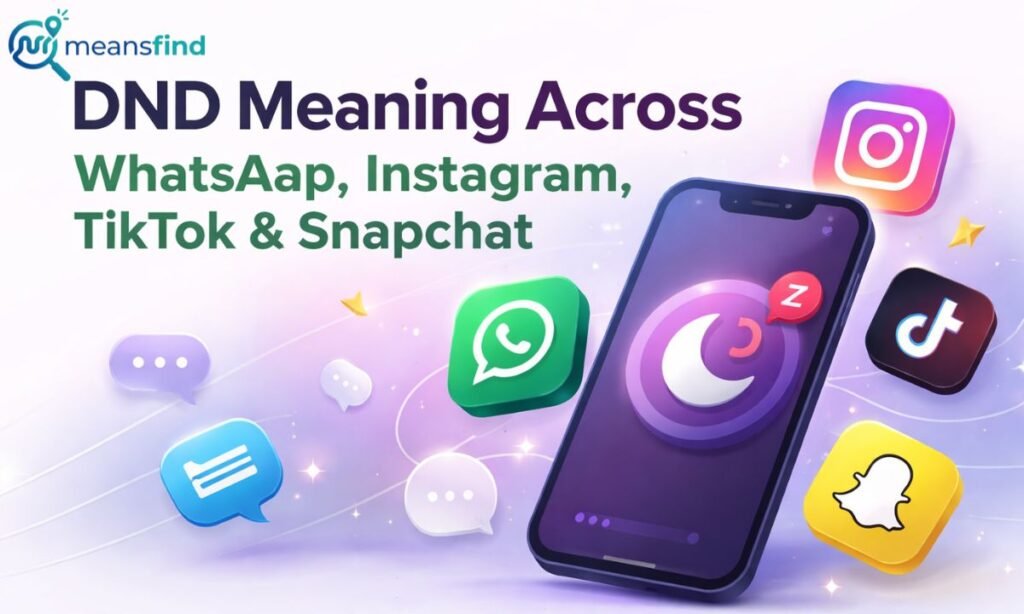
The core meaning doesn’t change much across platforms, but how people use and express it does.
WhatsApp is where DND appears most frequently as a status update. People set their status to “DND” to passively communicate unavailability to everyone on their contact list without sending individual messages. It’s also used in direct messages when someone wants to pause a conversation politely.
Example status: “DND 🔕 — back online tonight.”
On Instagram, DND tends to appear in bios and story captions. Someone might include it in their bio alongside other shorthand like “she/her” or “📍NYC” as a way of saying they’re not open to cold messages or unsolicited DMs.
It also pops up in Stories, especially during busy periods like exam season or work travel. Paired with a simple graphic or plain text, it acts as a broadcast to followers.
TikTok
TikTok’s comment sections and creator bios occasionally feature DND, though here it often carries a slightly more personal edge — creators use it to signal they’re taking a break from content creation or won’t be responding to comments for a while.
Snapchat
Snapchat users tend to use DND in their Snap score status, stories, or group chats. Because the app is primarily a real-time communication tool, DND on Snapchat almost always means “I’m not replying right now — don’t read into it.”
| Platform | Common DND Use | Tone |
| Status message | Practical, boundary-setting | |
| Bio or Stories | Lifestyle statement | |
| TikTok | Bio or comment reply | Creative/personal |
| Snapchat | Stories or group chats | Real-time unavailability |
Different Meanings of DND in Other Fields
Context matters enormously with this acronym. Here’s where DND shows up beyond texting:
Gaming: Dungeons & Dragons
This is the most significant alternative meaning. Dungeons & Dragons (often written DnD or D&D) is a legendary fantasy tabletop role-playing game first published in 1974 by Gary Gygax and Dave Arneson. Players create characters, roll dice, and navigate storytelling adventures guided by a Dungeon Master.
The game has had a massive cultural revival, especially following the success of Stranger Things, which introduced it to a new generation. In Discord servers, Reddit threads, Twitch streams, and gaming group chats, DND almost always refers to the game rather than privacy status.
“Our DND campaign starts at 7 — you in?”
Telecom: Do Not Disturb Service
In the telecommunications industry, DND is a formal, purchasable service that blocks unsolicited calls from telemarketers or robocalls. In many countries, there’s a Do Not Disturb registry where users can opt out of commercial calls. This is distinct from the casual chat usage but shares the same core concept — controlling who gets access to you.
Technology: Drag and Drop
In computing and UI/UX design, DND occasionally stands for Drag and Drop — the interface action of selecting and moving elements on a screen. Software developers and product designers sometimes use it as shorthand in technical documentation.
Military: Department of National Defence
In Canada and certain other countries, DND refers to the Department of National Defence — the government body overseeing military affairs. This usage is strictly institutional and never appears in casual conversation.
| Field | DND Meaning |
| Texting/Chat | Do Not Disturb |
| Gaming | Dungeons & Dragons |
| Telecom | Do Not Disturb service/registry |
| Computing/UI | Drag and Drop |
| Canadian military | Department of National Defence |
Also Read This:IBVS Meaning in Text Explained with Powerful Clarity
Common Confusions, Mistakes & Wrong Interpretations
Even a short acronym like DND can trip people up. Here are the most common misreadings:
Mistaking availability for attitude. Some people receive DND and immediately assume the sender is upset, annoyed, or brushing them off. In reality, DND is almost always a practical statement with no emotional charge. It’s a status update, not a rejection.
Confusing “Do Not Disturb” with “Do Not Reply.” DND doesn’t mean the conversation is over. It means the person needs a break. Expect a reply later — they’re not ghosting you.
Misreading gaming DND in a non-gaming context. If your friend who plays tabletop games says “DND tonight,” they’re probably planning a session. If your coworker says it, they almost certainly mean Do Not Disturb. Knowing your audience prevents confusion.
Using DND in formal professional emails. While DND works beautifully in a casual Slack channel or WhatsApp group, dropping it in a formal business email can come across as unclear or unprofessional. In that setting, spell it out: “I’ll be unavailable until 3 PM.”
Assuming DND is permanent. DND is always temporary. It signals a current state, not a permanent disconnection. Treating it like a block or a goodbye misreads the entire intent.
Similar Terms, Alternatives & Related Slang
DND doesn’t exist in isolation. Here are terms that share its function or vibe:
| Term | Meaning | When to Use |
| AFK | Away From Keyboard | Gaming/chat: temporarily gone |
| BRB | Be Right Back | Short, temporary absence |
| GTG | Got To Go | Leaving the conversation |
| OOO | Out Of Office | Professional unavailability |
| NRN | No Reply Necessary | Informational message, no response needed |
| TTY | Talk To You (later/tomorrow) | Ending the chat for now |
| Busy | Literally “busy” | Informal status in apps |
Key difference: DND is unique because it carries a connotation of intentional boundary-setting. AFK means you stepped away. DND means you stepped away and you don’t want to be pulled back in. That distinction matters in how people receive it.
Examples of DND in Real Chat Situations
Seeing it in action makes the meaning land faster. Here are realistic examples across different scenarios:
Example 1 — Between friends:
Alex: “You coming to the party tonight?” Jamie: “DND for the next few hours, studying. Text you after.”
Example 2 — Romantic / dating context:
Person A: “Hey, haven’t heard from you all day 👀” Person B: “Sorry! DND was on — had a rough morning. What’s up?”
Example 3 — Work chat:
Manager: “Anyone available to jump on a quick call?” Team member: “DND until 2 PM — in a client meeting. Free after.”
Example 4 — Group chat:
Group member: “DND tonight guys, early start tomorrow. GN 🌙”
Example 5 — Gaming Discord:
User: “DND session still happening Saturday?” Reply: “Yeah, 6 PM. Bring your dice 🎲”
How to Reply When Someone Says DND
Getting a DND message and not knowing how to respond is surprisingly common. Here’s a practical guide:
Do:
- Acknowledge it briefly and let them be. “No worries, talk later!”
- Send a short, low-pressure follow-up after you know they’re available.
- Respect the boundary — don’t double-text or push for a response.
Don’t:
- Bombard them with more messages trying to get a reply.
- Interpret it as anger or rejection without other evidence.
- Send a message that requires an urgent response if you know they’re in DND mode.
If you need something urgent: Acknowledge the DND status, but flag the urgency clearly. “I know you’re on DND — reach out when you’re free. It’s important but not an emergency.”
The golden rule: honor the boundary they communicated. That’s exactly what DND is asking for.
Is DND Still Popular? Trends & Online Usage
The short answer: absolutely. DND isn’t fading — it’s growing.
A few forces are driving its continued popularity:
The mental health movement. As conversations about boundaries, burnout, and digital wellness have become mainstream, DND fits perfectly into how people talk about protecting their peace. It’s not just slang anymore — it’s a mindset.
Smartphone integration. Because DND exists as an actual phone feature, it sits at the intersection of tech behavior and language. Every time someone activates their phone’s DND setting, the abbreviation gets more cultural reinforcement.
Remote work culture. Post-pandemic work habits normalized setting clear availability windows. DND slipped naturally from phone features into Slack channels, Zoom statuses, and calendar settings. Workers use it to communicate when they’re in deep focus mode without having to explain themselves every time.
Gaming growth. Dungeons & Dragons itself has seen a massive cultural comeback. Search trends for “DnD” and “Dungeons and Dragons” have climbed steadily through the 2020s, partly fueled by streaming, podcasts, and online play platforms. This has kept the gaming meaning of DND highly active in online spaces.
Gen Z communication style. Younger generations favor short, expressive language that sets boundaries without lengthy explanations. DND fits that style perfectly — it’s assertive, clear, and requires zero over-explanation.
Frequently Asked Questions
What does DND mean in texting?
DND stands for “Do Not Disturb” — it means someone is busy or unavailable and doesn’t want to be contacted right now.
Is DND rude to send?
Not at all. It’s a polite way to communicate unavailability without ignoring someone completely.
What does DND mean from a guy?
He’s likely busy or needs space — it’s a practical boundary signal, not an emotional one, unless context suggests otherwise.
What does DND mean from a girl?
Same core meaning — she’s unavailable right now. It could also be a self-care signal, indicating she’s taking personal time.
Can DND mean Dungeons & Dragons?
Yes, especially in gaming communities on Discord, Reddit, or Twitch — context tells you which meaning applies.
Is DND the same as being blocked?
No. DND is temporary and communicative — being blocked means they’ve actively cut off contact.
What’s the difference between DND and AFK?
AFK means you’ve stepped away momentarily. DND means you’re intentionally unavailable and don’t want interruptions.
How long does DND usually last?
It varies — from an hour to a full day. It’s always temporary unless stated otherwise.
Should I use DND in professional emails?
Avoid it in formal emails. Spell out “I’ll be unavailable until [time]” for professional clarity.
Is DND used in Instagram bios?
Yes — people include it in bios to signal they’re not open to unsolicited DMs or frequent messages.
Conclusion
DND is one of the most versatile and widely understood abbreviations in digital communication today. At its core, it means “Do Not Disturb” — a clear, respectful way of communicating that you need time, space, or focus without leaving people completely in the dark.
What makes DND interesting is the range it covers. It’s a hotel sign, a phone setting, a texting shorthand, a gaming community staple, and a mental health statement all wrapped into three letters. Understanding which meaning applies comes down to reading the context, knowing the platform, and understanding the person you’re talking to.
When someone sends you DND, the best response is almost always the simplest one: respect it, acknowledge it briefly, and reach out when they’re ready. And if you need to send it yourself? Don’t overthink it. DND is clear, kind, and universally understood — exactly what good communication looks like.

Aiden Ross is the creator of this website, where he shares simple and clear meanings of text, phrases, and modern slang. His goal is to help people quickly understand everyday language used in messages, social media, and conversations.


1 thought on “DND Meaning in Text: What It Really Stands For & How It’s Used”